Wednesday, August 05, 2026
Age of the Cell-Phone Battery

Wednesday, May 22, 2024
AI -- So Boring!
Wednesday, January 31, 2024
Chaotic Tech ???
Wednesday, April 05, 2017
No Dear, ISPs Are Not Websites
Snider, Mike: "ISPs Can Now Collect and Sell Your Data: What to Know About Internet Privacy Rules", USA Today (4/4/2017).
So here's an analogy: if 50 years ago AT&T (or whatever they called themselves back then) had kept records of all your phone calls and then started selling that information to the highest bidder -- would they have gotten away with it? I don't think so. (In fact, interesting research topic.)
ISPs are not websites. They're governed by different rules, regulated by different agencies and golly-molly, ya just can't get on the internet without them. That makes them a utility and frankly, there's no similarity to Facebook, Google, etc.
But, hey, we're living in a free country! There's nothing keeping those ISPs from setting up their own groovy websites so they can take advantage of the same benefits. Problem solved!
Thursday, October 29, 2015
Ask a Librarian
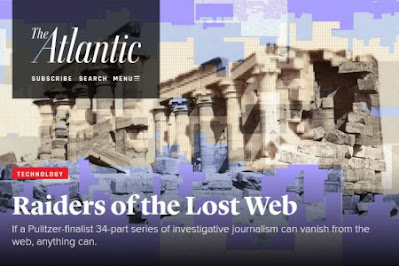
Interesting article looking at the transitory nature of the web. Technology and formats change all the time. In a sense, you never step into the same web twice. That said, the article subtitle, "If a Pulitzer-finalist 34-part series of investigative journalism can vanish from the web, anything can" -- just isn't true. I found most of the original "vanished" articles using the database Newsbank.
Saturday, January 25, 2014
Infrastructure on the Skids
"High speed" Internet provider AT&T tells me that my connection speed sucks but instead of trying to fix it, they're throwing in the towel and lowering my monthly rate.
"About Your AT&T High Speed Internet Service - We regularly test the speed of your AT&T High Speed Internet service to ensure you have the best Internet speeds possible. Recently we sent a letter to let you know that our testing has found that your modem speed is slower than the speed shown in the AT&T High Speed Internet Terms of Service. We're moving you to a lower-priced plan more in line with your current speed, although we cannot guarantee specific speeds."
Saturday, September 28, 2013
The Usual Disruption
File this under the 'Usual Disruption': Media types are dying, just dying, to jump from one technology to the other -- I mean, otherwise what do they have to talk about? In this episode, the usual disrupters are so hell bent on declaring email dead that they don't bother to consider an obvious possibility -- that maybe little Johnny or Suzie don't use their college-supplied email accounts because they're already using their own Gmail or Outlook accounts. Yeah, I know, common sense -- the ultimate disruption:
Technology and the College Generation
Regarded as too slow, e-mail is barely a second thought for college students, who prefer texting. But that sets them up for trouble with their professors.

UPDATE (9/29): P.S. Surveyed the student worker in today at the library. She says she uses email -- Yahoo -- all the time (since 5th grade). So that settles it: NYT article is totally clueless.
Saturday, June 18, 2011
Blast from the Past (1985): Tech-savvy Educators Choose ... LaserDisc!

"Rapidly changing technology confronts an educator with difficult choices in selecting new equipment. Will today's state-of-the-art equipment be tomorrow's Edsel? Obviously, educators must be careful in choosing a particular technology, making certain that it will play an important functional role in the educational system. The Laser Videodisc system is such a technology."*
________
*Schwartz, Ed. "The Educator's Handbook to Interactive Videodisc" (1985), p1.
Wednesday, March 16, 2011
Just Freeze Me
The Pew Research Center reports on the 'app gap':
"...[W]hile almost half of adults get local news on mobile devices, just 1 in 10 use apps to do so. Call it the 'app gap'."
Please just put me in cold storage for the next 5 years. I don't know how otherwise I'm going to endure the incessant call to build to particular brands (iPhone! iPhone! iPhone!) rather than to the platform in general. Hopefully by the time I'm revived, they'll have come up with a credible standard. I mean, that's how it usually works.
Monday, July 26, 2010
Humanities -- the Salvation of Technology?

"Engineers and computer scientists are not the only ones who have played important roles in building our new digital economy; students of the humanities and social sciences have played an equally significant role."
It reminds me of the time when two Business librarians asked me what it takes to become a programmer and I replied, a knowledge of English poetry.
That said, I've never been a fan of 'all one way or all the other'. I've seen too many ambitious initiatives go sour because the people implementing them simply lacked the technical chops to figure out whether they were headed in the right direction or whether the product just recommended by their vendors was worth its high price.
So although I still think a knowledge of English poetry is perfect preparation for programming there still is the part about learning the programming -- or the systems development or whatever technical aspect is required. Hearing that you don't need one or the other is probably a sign that you should go elsewhere for advice.
Sunday, August 30, 2009
Real-Time Web: It's More Than Just Twitter
I liked the article in BusinessWeek on the 'Real-Time Web'. It being BusinessWeek, they naturally devoted a significant portion to speculation on how to make money from this emerging trend and I had to laugh at the illusive precision of there being "at least $5 billion to be made on the real-time Web". What, just $5 billion?
Anyway, to give them their due, they correctly identify the trend:
In just the past couple of years, several developments have come together to make the Web more of a real-time experience: ubiquitous high-speed Internet connections; a growing number of mobile devices such as the iPhone with full Web browsers; and new Web technologies that enable instant transmission of messages and data. That mix has made always-on, real-time communications easy and addictive.
Okay, that sounds pretty 'real-time' to me. What I can't understand though is the focus, bordering on fixation, on Twitter in this and other articles. I mean, here it is, we've got an emerging technology that's giving us real-time group communication both in text, voice and video and the most impressive thing they can think of is a text stream limited to 140 characters?
You can't be serious. Off the top of my head, the number of possibilities include:
- Switch from traditional telephones to more computer- and network-based audio
- Conference calls on steroids -- now with video
- More ways to interact remotely at meetings and conferences -- routine live blogging and group chat are just the beginning
- Greater use of video chat -- for no better reason than there being a video camera on everyone's laptop
- Remote mentoring including real-time online editing of student research papers
- Easier and more dynamic ways to collect and organize research
And yes, I've seen the video introducing Google's ambitious Wave Project. It's nice but I'm most optimistic about initiatives that build on past successes and move forward by incremental steps. The kind of technology we've become familiar with as hallmarks of Web 2.0 (YouTube, Facebook, Flickr, etc.) has prepared us well for this next step.
[h/t ReadWriteWeb]
Friday, July 31, 2009

Thursday, May 21, 2009
History Repeats Itself as U of I's Global Campus Goes Belly Up
New York University is closing down its for-profit electronic learning operation, NYUonline, and moving some of its curriculum and staff into its School of Continuing and Professional Studies.U of I Global Campus (2009):
[University of Illinois] trustees meeting in Chicago voted to follow a faculty task force plan to scrap much of the current version of Global Campus.NYUonline (2002):
In two and a half years of operation, NYUonline received nearly $25 million from the university, but enrollment remained anemic at best: just 500 students at its peak.U of I Global Campus (2009):
The $10 million program had only attracted about 360 students as of last month.NYUOnline (2001):
The university blames last month's closure of the distance-learning company, called NYUonline, on the economy.U of I Global Campus (2009):
...[Prof. Nick Burbules] said, a global recession has changed conditions under which the older initiative was established.NYUonline (2001):
"I believe that the value of our work -- some of which will continue to be carried on by the university, and some non-academic portions of which may be acquired by third parties -- will become even clearer with time," [NYUonline CEO Gordon] Macomber said in the release.U of I Global Campus (2009):
Burbules said the 2.0 model draws from the UI's experience with the initiative. "I think what is driving this process is the belief that the mission of expanding the online offerings is important," he said. "I give [U of I President White] full credit for inspiring this work, and I personally believe it is the future of higher education."
Note, there were significant differences between the programs, though stated goals tended to shift over time. Nevertheless, what the two shared was an inability by the people in charge to truly understand what the technology was capable of and what it wasn't. Decision-makers themselves had no strong background in online content development for higher education. This lack of background made it hard to evaluate alternative strategies. Instead of identifying successful initiatives already in place and extending those, they chose to concoct their schemes out of whole cloth.
The outcome should come as no surprise.Tuesday, March 31, 2009
Conflicker Worm - The New Y2K
So yes, everybody and his mother has sent me a message about the Conflicker Worm that's supposed to strike on April 1.
All I can say is, April Fools to you too! ***
___*** I mean, some of us remember Y2K.
Monday, January 05, 2009
Bye-Bye Dailup at NYU
 Reading my copy of Connect Magazine, which the IT People at NYU are kind enough to still send me, I notice that they're discontinuing Dailup Service as of January 20, 2009.
That's a shame though probably long overdue. NYU Dailup service was my first gateway to the Internet way back in 1994. I had had a modem on my laptop since the late Eighties but the only time I actually used it was to dial into a special government number to download some unexceptional data. Dailing into specialized phone numbers was about all you could do with a modem back then -- that and then a bit later on, connecting to proprietary networks like AOL or CompuServe.
It's when I got to NYU in '94 and was able to connect to their Dailup service that this strange unfamiliar network called the 'Web' became accessible. This was the era of GIF images and Netscape 1.0. In fact, just before I got there, the Library at NYU had completed an initial effort to make content available online -- in Gopher.
Oh well. I used Dailup till sites like Napster started getting big, at which point I switched over to DSL from Verizon. Ah, the days of 28kbs and 56kbs connectivity!
Saturday, November 29, 2008
AT&T is the Death Star (HTC Fuze Edition)

Why did AT&T (and others like Verizon) have to make changes to it?
Why can't they just leave it as it is as the Touch Pro? I can't stand the fact that they had to change the keyboard to be different!
No tab and Ctl key.....come on!!!!!
The guy has a point.

First there's the load of AT&T crapware that's included. You can't escape this since the good folks at AT&T thoughtfully re-engineered the default interface to include a prominent link to it. It mainly features fee-based services that ordinarily can be found elsewhere for free. Did I mention that you have to hack into the system to get rid of this stuff?
But back to the above lament.
The keyboard on earlier versions of this phone only had four rows. This allowed for larger keys. By squeezing in a fifth row, HTC, the manufacturer, had to reduce the size of the other rows and hence the keys. This made the keyboard slightly more difficult to use but no doubt HTC felt this reduction in functionality was justified since consumers now had a 'full qwerty' keyboard including a row of numbers.
Unfortunately when AT&T got its hands on the device, it simply said, 'qwerty, schmerty' and replaced the top row of numbers with punctuation marks. Worse, it replaced the normal function of certain keys on the lowest row with (surprise, surprise) yet more links to its fee-based proprietary services.
There is a conflict of goals here. The consumer wants a device to communicate with while the company wants a gateway to its proprietary fee-based services. This conflict results in interface decisions that alter how hardware and software traditionally function.
To the question then, what would a keyboard or operating system look like if it were designed by a telecommunications company, we now have an answer. For those of us concerned with the results, working towards a regulatory framework that separated the two -- i.e. the provider of the network from the provider of the network device -- might be a safe option.
Tuesday, November 18, 2008
How Dare You Call My Laptop a Technological Dinosaur

Every once and a while I come across an article which pretty much declares any device larger than a cellphone as dead because cellphones are what the teens are using and hence everything else is on the road to extinction.
This is silly.
I use my smartphone/pda/call-it-what-you-like -- all the time but even I know it doesn't replace my need for larger devices depending on what I'm doing.
I'm not going to write my research paper on one, for example, for the same reason that I wouldn't do the same, twenty years earlier, on the back of an envelope. You choose the tool to fit the job.
Wednesday, January 03, 2007
Best & Worst of the Internet - Circa 1994

Slashdot has a link to Internet World's "Best and Worst of 1994 and Predictions for '95"
A number of people were asked to contribute and we're brought back to the pre-Netscape days of Mosaic when the 'Net was in transition from a preserve for academics and government employees to a more general and commercial audience.
Here's are some of the remarks:
BEST:
Best public display/demo of the Internet: The Shoemaker-Levy comet vs. the planet Jupiter. [NASA had put up pictures of the comet hitting Jupiter on its nascent web-site. This captivated people as an example of how visual information could be accessed.]
The proliferation of the World-Wide Web. Unlike other areas of the Net, once you access the Web, it makes no difference whether you're a new user or an old pro. The Web graciously accommodates all. [the Web was WYSIWYG!]
Media coverage. Sure, some of that coverage seems clueless, and some of it focuses; foolishly, but not surprisingly; on the seedier side of the Net (such as pornography and electronic stalkers). But 1994 saw the Internet finally hit the mainstream. Time and Newsweek now routinely print letters received through e-mail, and more importantly, it's no longer a novelty. The coverage in magazines on the supermarket check-out line has helped make the other "best" things possible.
Governance. It's been engineers; rather than lawyers and legislators; that have run the Internet. It would be nice to keep it that way.
WORST:
Hordes of users from commercial on-line services such as America Online CompuServe, and Prodigy have come onto the Net. This has burst the Internet open beyond the borders of a relatively well-trained and well-mannered few, and is the first major step toward diluting the Internet into a sea of hostility and miscommunication, much like the real world. While this did not happen solely in 1994, this year has seen the floodgates simply trampled over, as it were, and the clueless newbies are a-stumblin' in!
What is it about the World-Wide Web that makes everyone want to stick 100-K pictures on their home pages? [Originally only 'Gif' images worked on the Web. Jpegs came a year or two later.]
The organization of the World-Wide Web. I love the Web, but finding something specific on it is a nightmare. And because the Web is growing by leaps and bounds, I just don't see things getting easier anytime soon. [Search engines anyone?]
Hype. Is there anyone who isn't carsick from the phrase "Information Superhighway?"
(image of a NASA Web Page on Jupiter circa 1994 courtesy Byte Magazine)